Digital Culture and Religion in Asia by Sam Han Kamaludeen Mohamed Nasir
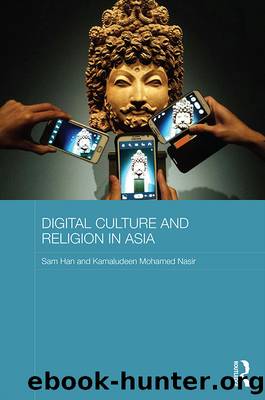
Author:Sam Han, Kamaludeen Mohamed Nasir [Sam Han, Kamaludeen Mohamed Nasir]
Language: eng
Format: epub
Tags: Social Science, Ethnic Studies, General, Regional Studies
ISBN: 9781317580157
Google: X_ePCgAAQBAJ
Publisher: Routledge
Published: 2015-09-16T02:49:03+00:00
Digital Islam
The Internet and social media trends reflect the increase in the usage of digital space among many countries in Southeast Asia. The adoption of smartphones en masse is responsible for the increase in Internet penetration as noted in Internet World Stats. In 2011, nearly 70 percent of those connected to the Internet in Singapore and Malaysia had a smartphone, while the global mean was 52 percent. Although the numbers for Indonesia are not high, sales of smartphones are projected to rise at a compound yearly growth rate of 31 percent from 2011 to 2016. Indonesia is also third in the world ranking of Facebook member numbers.
We have discussed earlier the idea of âreligious diaspora.â To be sure, many attempts at siphoning Islam online are the result of the necessary constraints of minority living in new and foreign lands. The MuslimSpace, DigitalHalal and Muxlim initiatives born around 2006 are a case in point. These initiatives were set up by Mohamed El-Fatatry, a United Arab Emirates-born Egyptian, studying in Espoo, Finland. These Muslim-oriented websites aim to provide a discussion site for Muslims. However, despite initial success, these sites have struggled to survive essentially because they replicate the services of the main websites such as MySpace and Facebook, just catering specifically to Muslims. As a result, Muxlim shut down its social networking services in 2012 after incurring years of financial losses and shifted other services such as IslamicTorrents.net to another platform.
The message of MuslimSpace is that Muslims are happy, completely ordinary people like any others ⦠Racism on the Net can be pretty ugly stuff. For instance, if some Arab takes part in an online discussion on a message board and feels heâs been given a bad time, he might next turn to the sites run by extremist organisations. In this respect MuslimSpace offers an alternativeâa moderate forum for the exchange of ideas.
(Rantanen n.d.)
A struggle that these Muslim service providers grapple with is an existential one and speaks to the very nature of identity formation. What is necessarily Islamic or even Muslim about these sites? How do they address the needs of the Muslim ummah today? Can other non-religious affiliated and more mainstream sites take up their function? Failure to address these fundamental questions will often render the websites irrelevant. A website that is going strong, however, is the UK-based Productive Muslim setup, which was established in 2008 as an educational hub. Its team, which comprises a global group of volunteers, combines modern methodologies of learning with an Islamic essence and has already garnered more than a million fans on its Facebook page and several million views for its YouTube videos. In 2013, Productive Muslim went on a seminar tour to Southeast Asian countries like Malaysia and Singapore where it has a strong following.
These websites with an international reach present a ready platform for Muslims in Southeast Asia who live as majority populations to engage with Muslim minorities from the West. An important aspect of this âglobalization from belowâ is what Anderson calls âcreolization.
Download
This site does not store any files on its server. We only index and link to content provided by other sites. Please contact the content providers to delete copyright contents if any and email us, we'll remove relevant links or contents immediately.
Cecilia; Or, Memoirs of an Heiress — Volume 1 by Fanny Burney(32548)
Cecilia; Or, Memoirs of an Heiress — Volume 2 by Fanny Burney(31947)
Cecilia; Or, Memoirs of an Heiress — Volume 3 by Fanny Burney(31932)
The Great Music City by Andrea Baker(31917)
We're Going to Need More Wine by Gabrielle Union(19035)
All the Missing Girls by Megan Miranda(15962)
Pimp by Iceberg Slim(14489)
Bombshells: Glamour Girls of a Lifetime by Sullivan Steve(14058)
For the Love of Europe by Rick Steves(13933)
Talking to Strangers by Malcolm Gladwell(13350)
Norse Mythology by Gaiman Neil(13349)
Fifty Shades Freed by E L James(13233)
Mindhunter: Inside the FBI's Elite Serial Crime Unit by John E. Douglas & Mark Olshaker(9324)
Crazy Rich Asians by Kevin Kwan(9280)
The Lost Art of Listening by Michael P. Nichols(7494)
Enlightenment Now: The Case for Reason, Science, Humanism, and Progress by Steven Pinker(7306)
The Four Agreements by Don Miguel Ruiz(6745)
Bad Blood by John Carreyrou(6611)
Weapons of Math Destruction by Cathy O'Neil(6267)
